Shoemaking Process
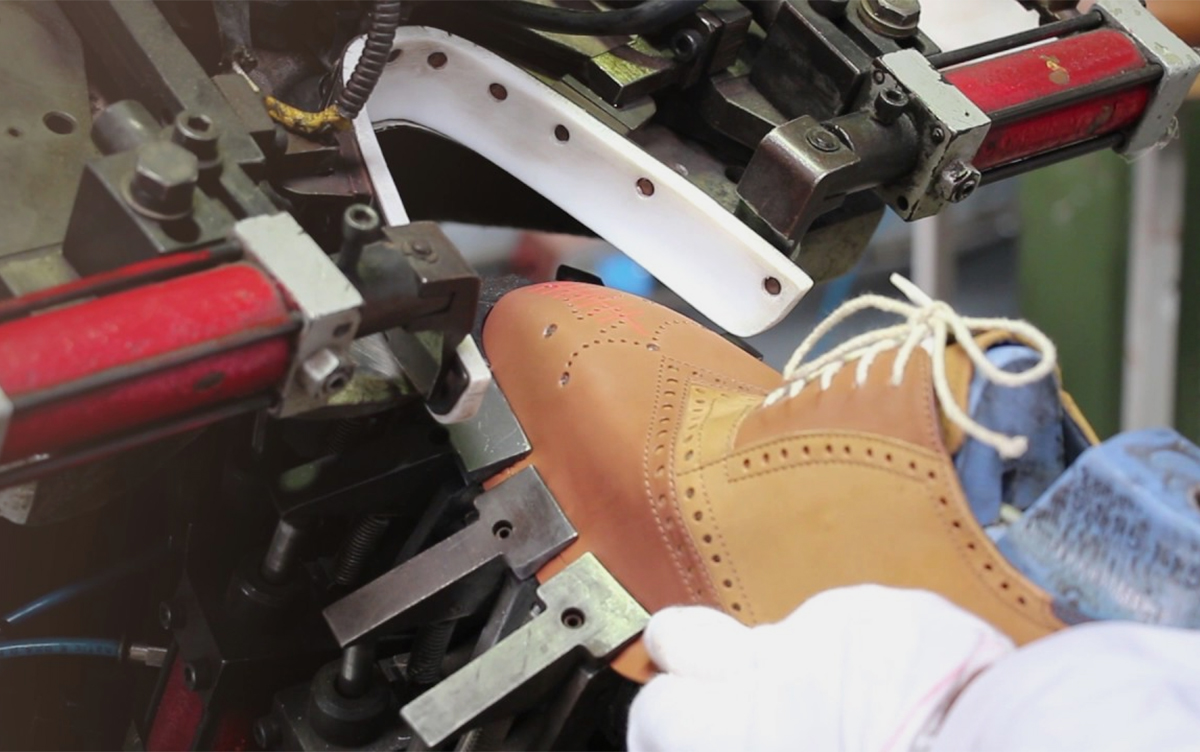
Shoes are indispensable in our life. Here are ten shoe-making techniques for you, I hope you will.
1. Glue shoe process:
Also known as the cold bonding process, it is a process method that uses adhesive to connect the upper, insole, and outsole together. Due to the difference in the material of the upper and sole bonding surface, the type and nature of the adhesive used are also different, such as neoprene adhesive, polyurethane adhesive, SBS adhesive, etc. Due to the simple process, short production cycle, high production efficiency, low manufacturing cost, rapid change of color varieties, and easy expansion and reproduction, the gluing process is the most widely used assembly process in the footwear industry, accounting for 80% of the total footwear products. %above. This process is most used in leather shoes and sports shoes.
2. The process of sewing shoes:
Also known as the sewing shoe process, it is a process method that uses sewing thread to sew the upper, sole, and other connecting parts together. The sewing thread used is ramie thread, which has the characteristics of high strength, low elongation, fast moisture absorption and moisture removal, and high wear resistance. The process of sewing shoes is the most widely used in leather shoes, mainly including welt leather shoes, cuffed leather shoes, and perforated leather shoes. Although its craftsmanship has a long history, complex operations, and low production efficiency, its product structure, style, and durability are irreplaceable by other craftsmanship. Coupled with the development and improvement of machine sewing technology, it is more in line with the needs of modern production and consumption, so it occupies an important position in footwear products, and has auxiliary functions in the process of adhesive shoes, and thus produces adhesive seams. craft.
3. Molded shoe process:
It is a process method of bonding the outsole and the upper together by using the rubber outsole flow and the clamping pressure generated during the mold vulcanization process. The outsole and the upper are bonded and connected under the high temperature and high pressure of rubber, so the molded shoe process has the characteristics of firm bonding of the upper and the bottom, not easy to open the glue, wear-resistant, and flexing. Due to the long mold production cycle and slow change of color varieties of molded shoes, it is suitable for the production of large batches of products. Labor protection shoes, hiking shoes, military and police shoes, and other products are mostly produced by a molding process. The molding process is a mold vulcanization process derived from the moldless vulcanization process, which is mostly used for leather shoes.
4. Injection shoe process:
Also known as the continuous injection molding process, it is a process method in which molten plastic is injected into the outer mold and bonded with the upper. The material of the outsole is mostly polyvinyl chloride, thermoplastic polyurethane, thermoplastic rubber, and so on. The process is to complete the bonding and assembly of the bottom and the bottom under the conditions of automatic feeding, automatic plasticization, automatic measurement, automatic injection, automatic mold closing, and opening, and automatic molding, so it has the advantages of high production efficiency and automatic production. It has applications in the production of leather shoes, cloth shoes, sports shoes, and plastic shoes.
5. Vulcanization shoe process:
It is a process method in which the outsole, welt, and outer cover are bonded to the shoe upper, and then heated and pressurized in a vulcanization tank to form a vulcanization process. The outsole of this process is divided into dieless (calendering) forming and die forming. Because the process is relatively rough and it is difficult to control the quality, usually only low-grade products can be produced. In recent years, due to the introduction of foreign advanced production technology, product quality has been greatly improved. Because vulcanized shoes are comfortable and economical to wear, and have high efficiency and low cost in production, this process is still used in the production of cloth rubber shoes, rubber shoes, and leather shoes, and the production volume is large.
6. Goodyear Welted
This should be the most familiar shoemaking process. The extension strip is used as the connection between the upper and the outsole, and the hollow part is filled with cork and steel strips. It has the advantages of convenient bottom change, good foot feel, and durability. Because this is the most common process of redwing. Let's give a detailed introduction to the functions of each part of the Goodyear process.
(1). Insole cover. The soft leather layer covering the midsole is in direct contact with the foot.
(2). The insole of the shoe is located under the insole of the shoe to increase the stability of the sole structure.
(3). Outsole: The part of the sole that directly contacts the ground is usually made of thick cowhide, which has the function of enhancing wear resistance.
(4). Welt: This is an important part of the Goodyear process. Connecting the upper, the insole, and the outsole effectively supports the entire shoe structure. The shoes are not easily deformed after being worn for a long time.
(5). Cork filling layer: cork filling layer is set in the hollow area of the sole. When the wearer walks, it can play the role of elasticity and stability; at the same time, it has the function of moisture absorption and perspiration.
(6). Heel: It is composed of several layers of hard cowhide heels; some functional pads are added; in the heel position, wear-resistant rubber sheets are used to slow down the wear of the heel.
(7). Spring sheet shank spring: Generally made of elastic steel sheet material, it is placed in the hollow layer between the midsole at the arch of the foot and the extension layer, which acts as a buffer when walking. A technique that is rare in work boots but often seen on high-end shoes is Channel welt (embedded Goodyear method). After the groove is punched out on the outsole, the stitches are buried, and finally, the groove is sealed so that the outsole can present an extremely simple and delicate effect.
7. Veldtschoen/Stitch Down (double W is commonly used)
Veldtschoen is the only construction method that can be completely waterproof. Unlike the general production method, Veldtschoen uses a double-layer upper, one layer is turned outward and the other layer is folded inward, so it is difficult for moisture to penetrate inside. In terms of stitching, one runs through the midsole and the other runs through all the bottoms. British shoe manufacturers have boots of this construction method in the country series to meet the needs of hunting customers who travel through mountains and waters. Wesco also uses the same construction method (they call it Stitch-Down), but does not use a spreader (since the stitches run through all the bottoms, the spreader is no longer connected, so it is optional), according to Wesco USA According to the dealer's introduction, this method can also reduce the use of nails and avoid the corrosion of the cortex after the metal is oxidized.
8. Moccasin This practice is also called bun shoe practice.
As an Indian shoe-making process, this is one of the most primitive ways of making shoes. The upper wraps the entire foot 360 degrees and is only cut and sewn on the top. Many manufacturers of moccasins will advertise "True Moccasin construction" which means that the upper is completely wrapped, and the imitation Moccasin method will cut corners and save the bottom part. Manufacturers of modified Moccasin, such as Russell Moccasin, use the Double Vamp (double-layer upper) form to stagger the stitching to achieve waterproofing. Arrow Moccasin in Massachusetts still sticks to the ancient craftsmanship of the Indians, while Quoddy in Maine has both. This traditional American shoemaking method is also an important part of Amekaji.
9. Norwegian (the famous Norwegian seam)
Although called the "Norwegian" method, this technique was actually invented by Italians. Its main purpose is to enhance water resistance based on the Goodyear method. Therefore, compared to the Goodyear method in which the upper is stitched inward and the extension strip is sewn, the upper of the Norwegian method is turned outward, and stitches are used on the side to penetrate to the insole. The stitching on the outer ring is roughly the same as the Goodyear method, but it is worth noting that in the Norwegian method, the extension is decorative, because the upper does not need to be bonded to the sole through the extension.
10. Blake is also known as the inner branch method
This is a relatively lightweight shoemaking technique, and the leather is turned inside out and sewn directly onto the sole, so no extension is required. The advantage of this method of production is that it produces more elegant shoes. Because of the lack of extension strips, the sole can be made quite thin and can be cut close to the upper to achieve a more slender effect. However, the disadvantages include not much waterproof, being easy to damage, and difficult to replace the bottom, etc. (The machine for making Goodyear structure is much more common than Blake's machine). Many Italian and French shoe factories, such as Berluti, use this shoemaking process, and it is also common in lightweight shoes like the Loafer.
As you can see, 1, 3, 4, and 5 are modern mechanical shoemaking processes, and many shoe factories have greatly saved time and manpower, and material resources when using these processes. But luxury brand shoes are basically 2, 6, 7, 8, 9, and 10 handmade shoemaking processes. There is no superior or inferior in shoemaking craftsmanship, no matter what craftsmanship, as long as it can make good shoes and comfortable shoes, it is the best craftsmanship! : This is an important part of the Goodyear process. Connecting the upper, the insole, and the outsole effectively supports the entire shoe structure. The shoes are not easily deformed after being worn for a long time.
Top 5 Best-Selling Sneakers of the Year
Related Article
